On Pearls
Quality, told honestly.
The GIA grades pearls on seven value factors, and six of them apply to a single pearl. Here is what we look for, where ours come from, and what to expect from the one you'll find.
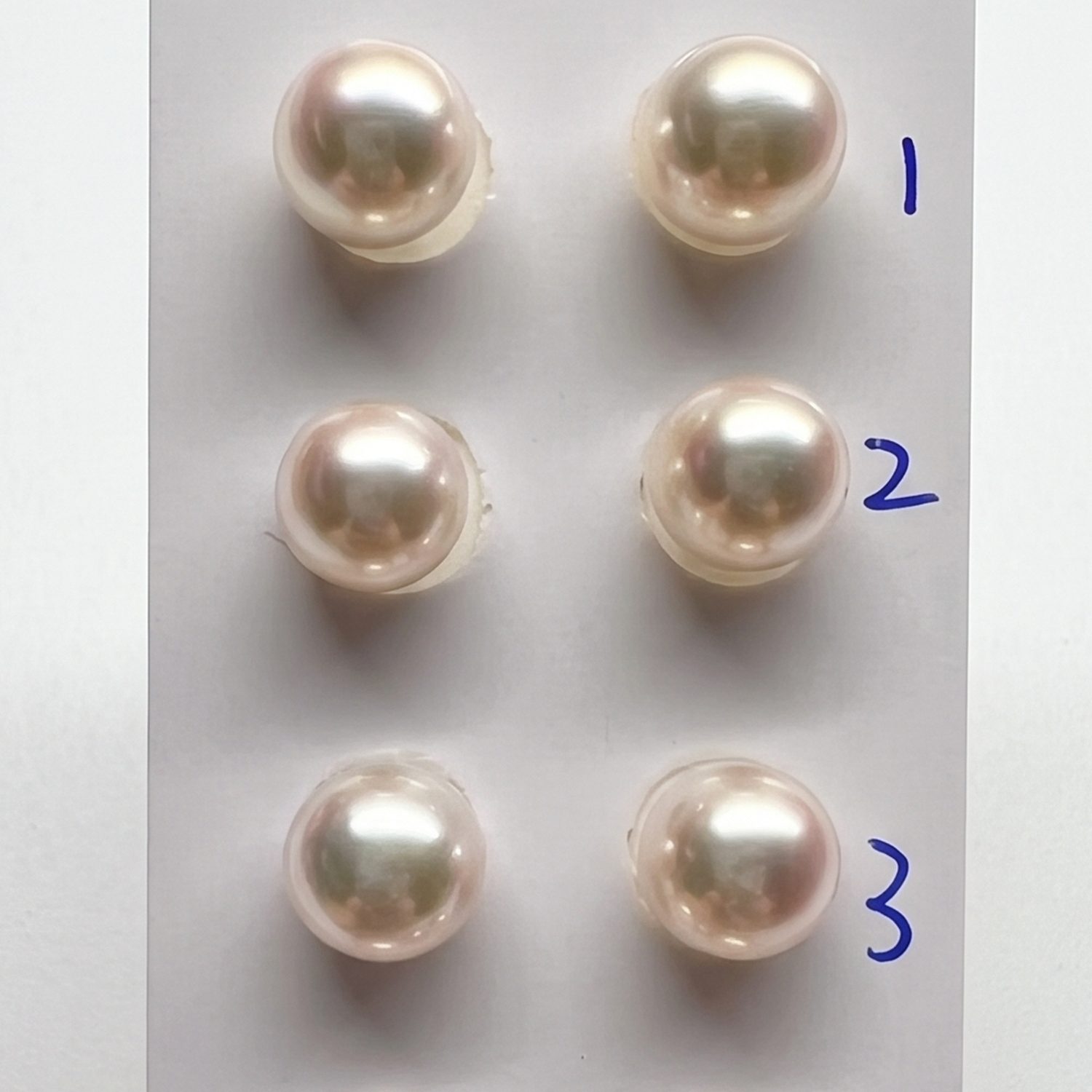
Lustre
The most important factor.
How bright and sharp is the reflection? High lustre means you can see yourself in the pearl. Low lustre reads chalky and dull.
It is the single thing that separates a beautiful pearl from a mediocre one at a glance. Japanese Akoya pearls are famous for theirs.
A mirror-like reflection. A sense of inner glow that holds across the surface.
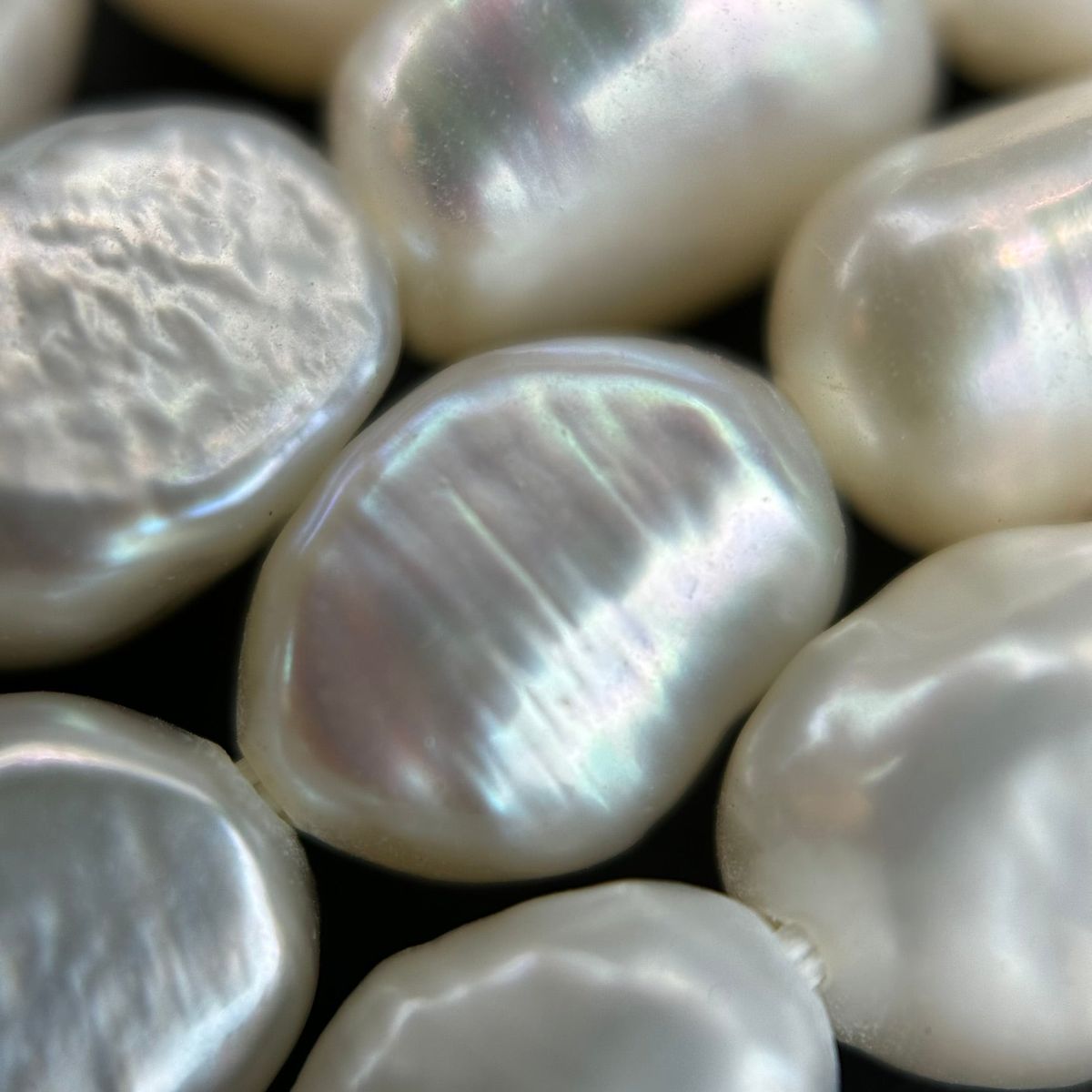
Surface
The character of the nacre.
Spots, bumps, wrinkles, and pits are blemishes. Some are visible to the unaided eye, others only under magnification.
A few small ones are normal and frankly lovely. Heavy blemishing throughout is a quality issue.
We buy within a set grade from suppliers we work with closely. Our pearls are unsorted, so small spots, scratches or dents may still appear, and we set the cleanest side facing out.
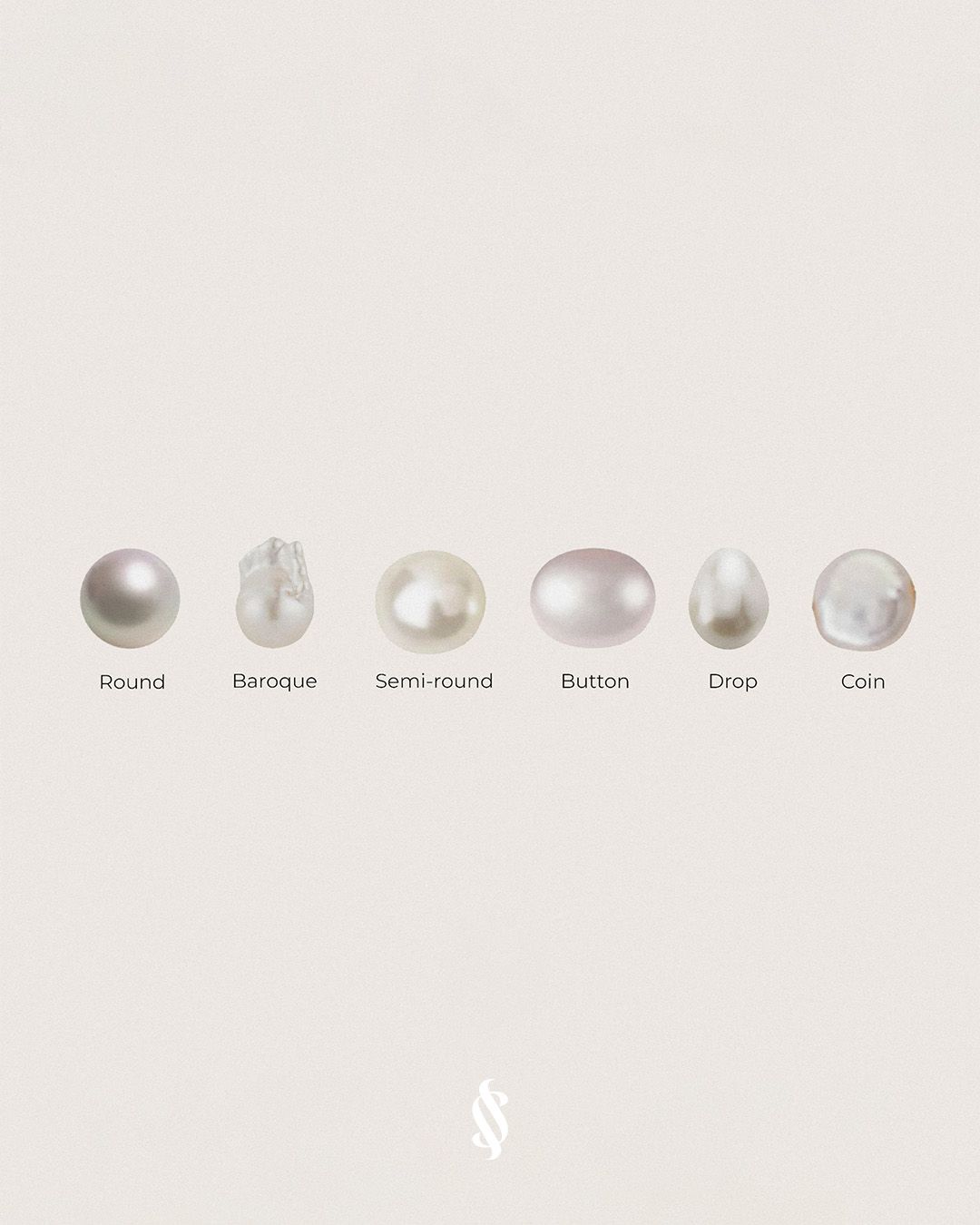
Shape
Round is rarest. Round is not the only beauty.
Near-round, oval, button, baroque, and circle baroque are all real pearl shapes. Baroque and near-round pearls are wonderful for the workshop because each one is unique.
The guest who finds a perfectly round pearl receives a small gift of geometry.
Symmetry where it counts. Presence and balance in the shapes that come.
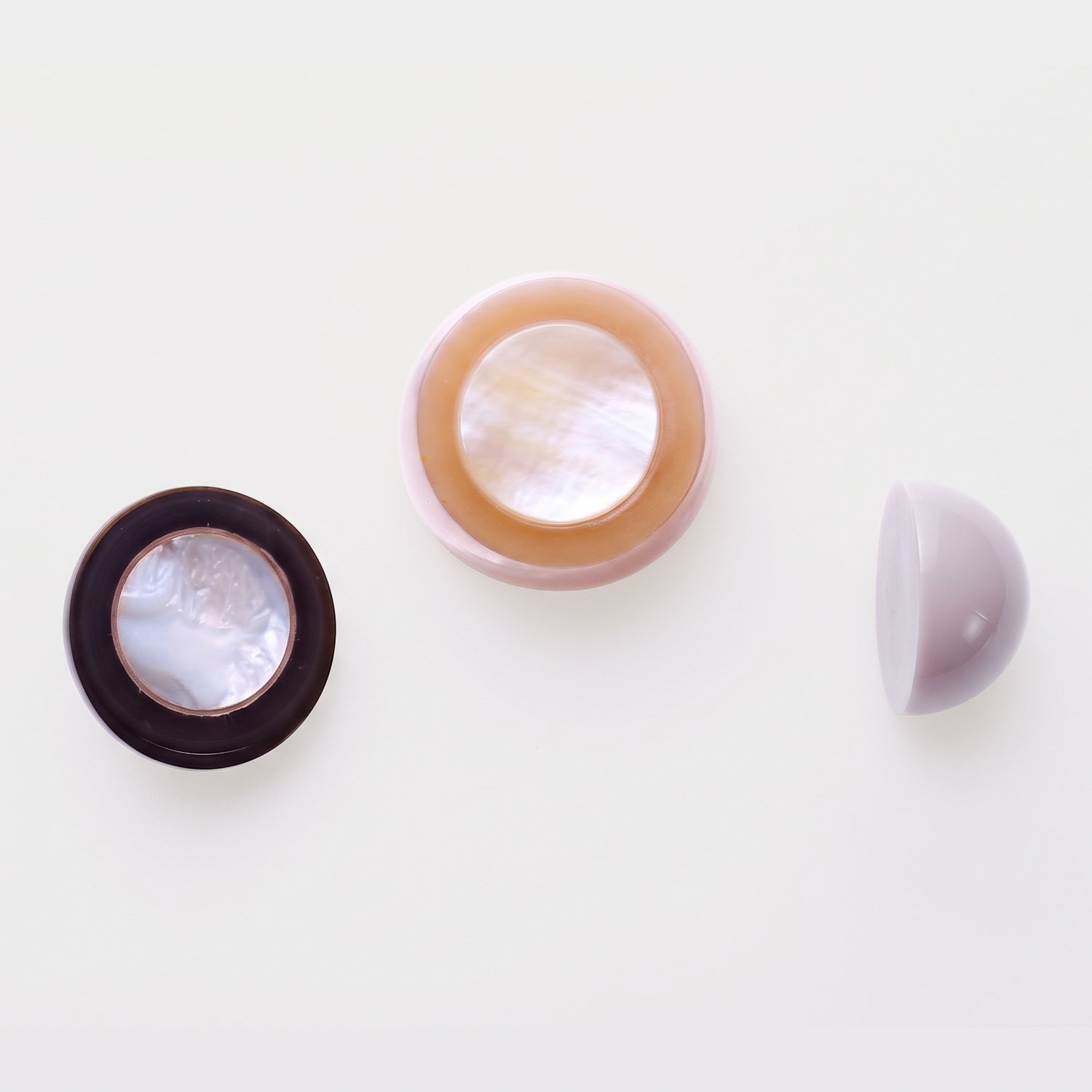
Nacre thickness
The reason a pearl lasts a lifetime.
Nacre is the iridescent material the mussel or oyster deposits in layers around the irritant inside it. Thicker nacre means better lustre, more durability, more value.
Many saltwater pearls grow around a bead nucleus, and that on its own says nothing about quality. What matters is how much nacre the oyster laid down over it.
At least five years for our premium freshwater and about three years for baroque and Edison, long enough to grow real nacre. No thin-coated bead pearls. Ever.
Colour
Bodycolour, overtone, and orient.
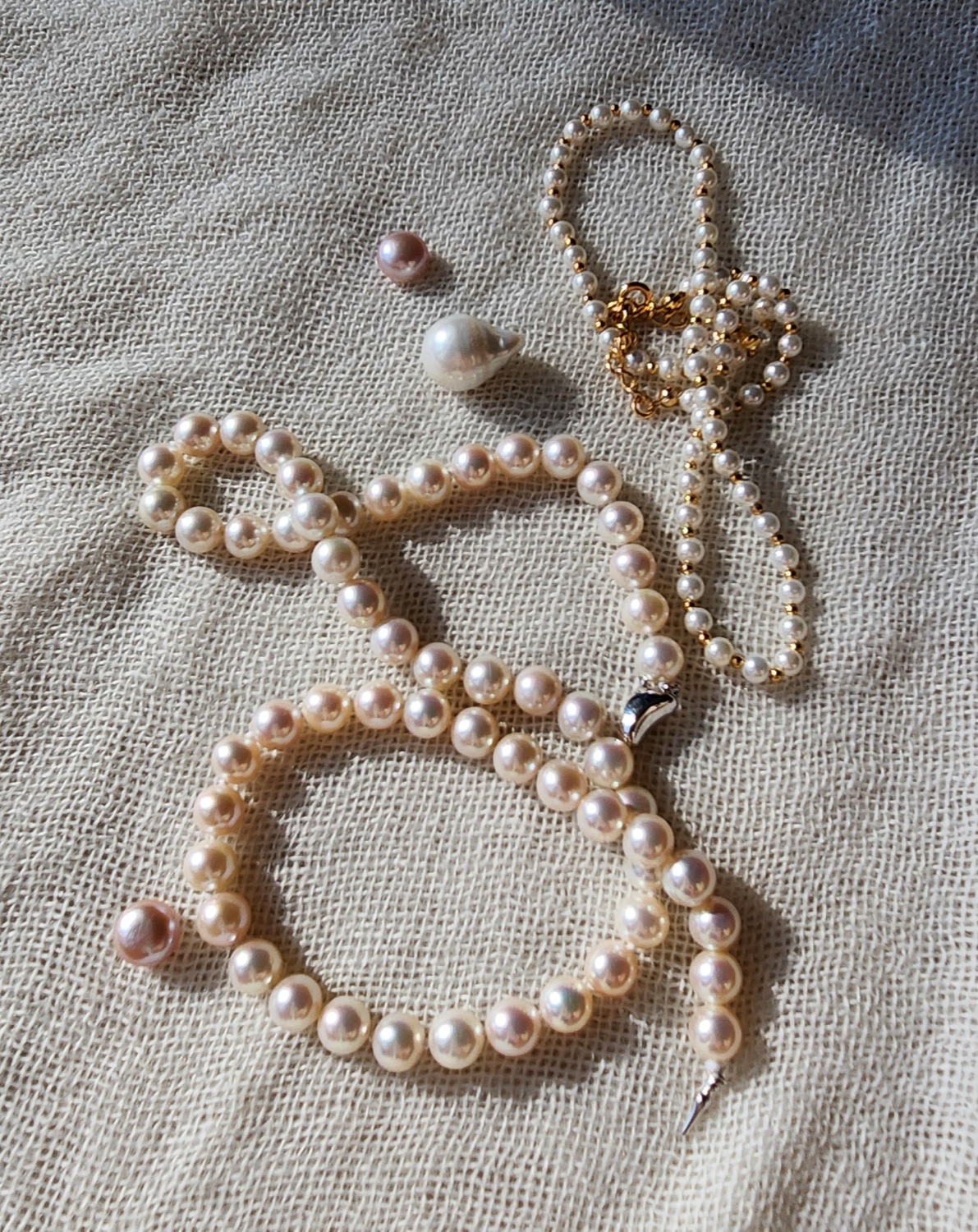
Bodycolour is the main colour you see. Over it, some pearls carry an overtone, a translucent wash of pink, green, or blue.
Fewer show orient, the rainbow shimmer that moves across the surface as the pearl turns. Which colours are prized depends on the type: white and silver in Akoya, white and purple in freshwater.
Whatever colour your mussel grew. It is opened in front of you, so the colour you see is the one it came out with.
Size
Only meaningful within a type.
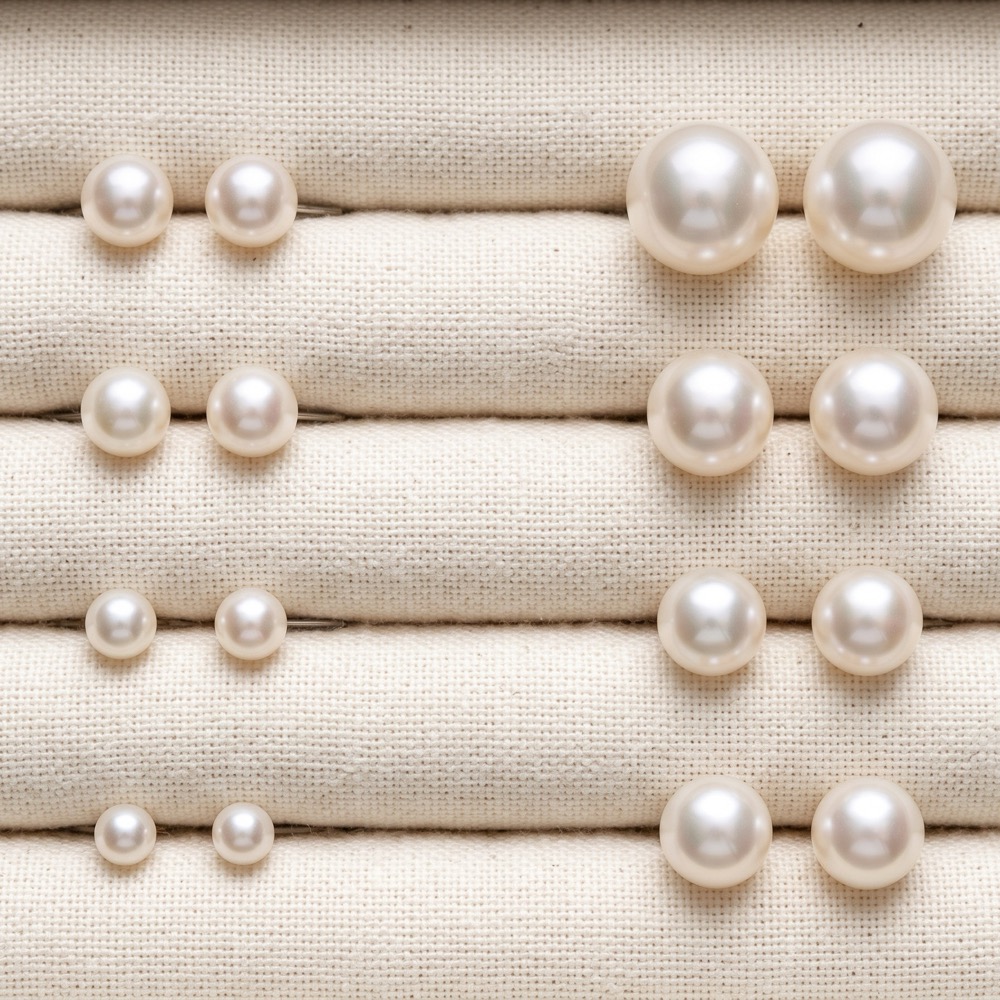
Size is stated in millimetres, rounded to the nearest half. Within one type of pearl, larger is worth more when everything else is equal.
Across types it tells you very little: an 11 mm South Sea pearl is common, while an 11 mm Akoya is rare, so the rarity is the valuable one.
Ours typically run 6 to 10 mm, which sits well in a pendant or a pair of studs.
6 to 10 mm typical. We choose for lustre and nacre first, and let size fall where it falls.
Matching
The seventh factor, and the one we do not grade.
Matching measures how well two or more pearls agree in a strand or a pair. It is a real part of the GIA system, and the one that has nothing to say about your pearl.
Your pearl is judged on its own, so there is nothing to match it against. We have listed it here rather than quietly leaving it out.
What's inside any given mussel is the wonder.
Every mussel comes from suppliers we've vetted, raised for five years for our premium freshwater (three years for baroque and Edison) and chosen to a quality standard.
We ask each supplier for cultivation periods, and we've opened and inspected samples ourselves.
- Nearly all are bleached to even out colour
- Then sorted and matched, with the most spotted set aside
- Ours are opened on the spot, so they skip both
- A real pearl, well-formed.
- Nacre thick enough to last decades.
- Lustre within our grade range.
- Honest answers about anything you ask.
- A perfectly round pearl, every time.
- A specific colour or size.
- A spotless surface.
- An identical pearl to anyone else's.
A pearl is not a diamond. It is grown, not cut. It carries the history of the animal that made it. The small irregularities are not flaws. They are the signature of a thing made by life.
Pearl FAQ
What is the difference between freshwater and Akoya pearls?
Freshwater pearls grow in mussels in lakes and ponds, and are usually solid nacre all the way through, with a soft, warm lustre and gently varied shapes.
Akoya pearls grow in saltwater oysters around a round bead nucleus, which gives them near-perfect roundness and a mirror-bright lustre.
Ours are freshwater, from Zhuji, China. Our premium freshwater pearls grow for at least five years and are typically 6 to 10 mm. Edison and baroque pearls are available as upgrades, and we are sourcing a Japanese Akoya upgrade now.
What is an Edison pearl?
An Edison pearl is a freshwater pearl grown around a round bead. It is often called the freshwater answer to Akoya: near-perfectly round with a mirror-bright shine, but grown in a freshwater mussel rather than a saltwater oyster.
Farmers set the bead inside a mature mussel, which coats it in thick nacre; ours grow about three years in all. GIA calls this the coin-bead/spherical-bead method, and Edison is the trade name for its finest round pearls.
At Atelier Jyu they are an upgrade: you open a mussel that holds a pair. On the Nina necklace and bracelet it is set as one standout pearl, and on the Nina earrings as the lower pearl.
What is a baroque pearl?
A baroque pearl is any pearl with an irregular, free-form shape rather than a round one. Curves, ridges and the occasional tail make each one unique, and the light moving across those curves gives it a lustre all its own.
At Atelier Jyu baroque freshwater pearls are an upgrade. They fit every Nina and Petra piece, and the Vivienne earrings, where the pearl swings free below the frame.
How can you tell if a pearl is real?
Rub it gently along the edge of your front teeth: a real pearl feels faintly gritty, because nacre is built in fine layers, while glass or plastic feels smooth.
Real pearls also show small surface marks and a depth of lustre that imitations, usually glass under a pearly coating, cannot copy. A gemologist can confirm it for certain with magnification or X-ray.
At Atelier Jyu the answer is in your hands: you take the pearl out of the mussel yourself.
Find your pearl.
Sessions launch Spring 2027. Waitlist members are invited to book before we open to the public.
Join the waitlist